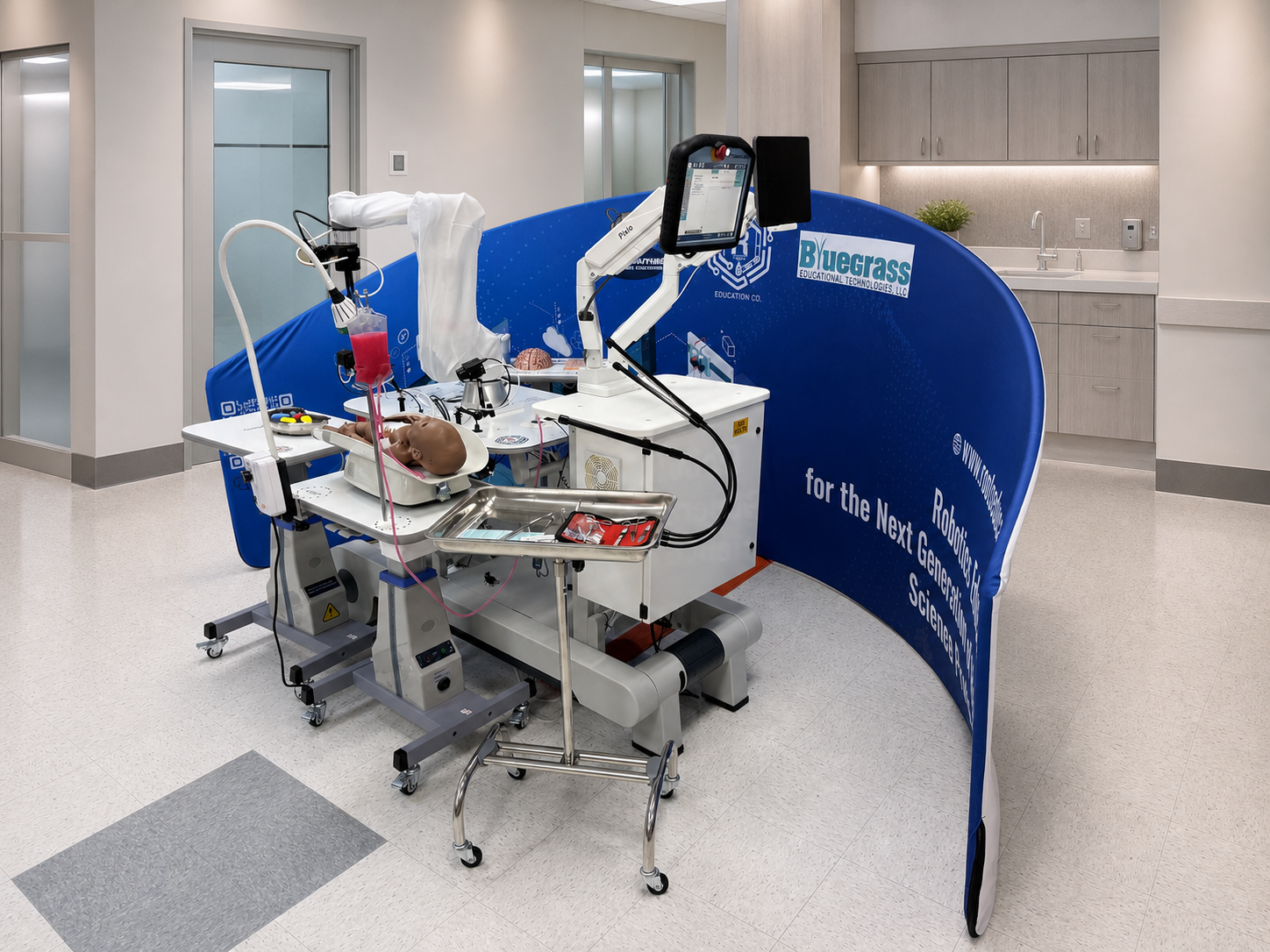
Where healthcare education meets collaborative robotics
The CARE Series is ROOTS Education’s robotically assisted medicine, or RAM, education and simulation platform. It gives CTE programs, high schools, technical colleges, community colleges, universities, workforce organizations, and healthcare-industry partners a practical way to introduce medical robotics alongside foundational healthcare knowledge.
CARE is built for education. It does not replace clinical instruction or professional licensure requirements. Instead, it creates a controlled setting in which learners can study robotic systems, safety, visualization, dexterity, programming, and healthcare workflow concepts without using equipment on patients.
CARE in the learning environment
See the complete CARE education and simulation system in action.
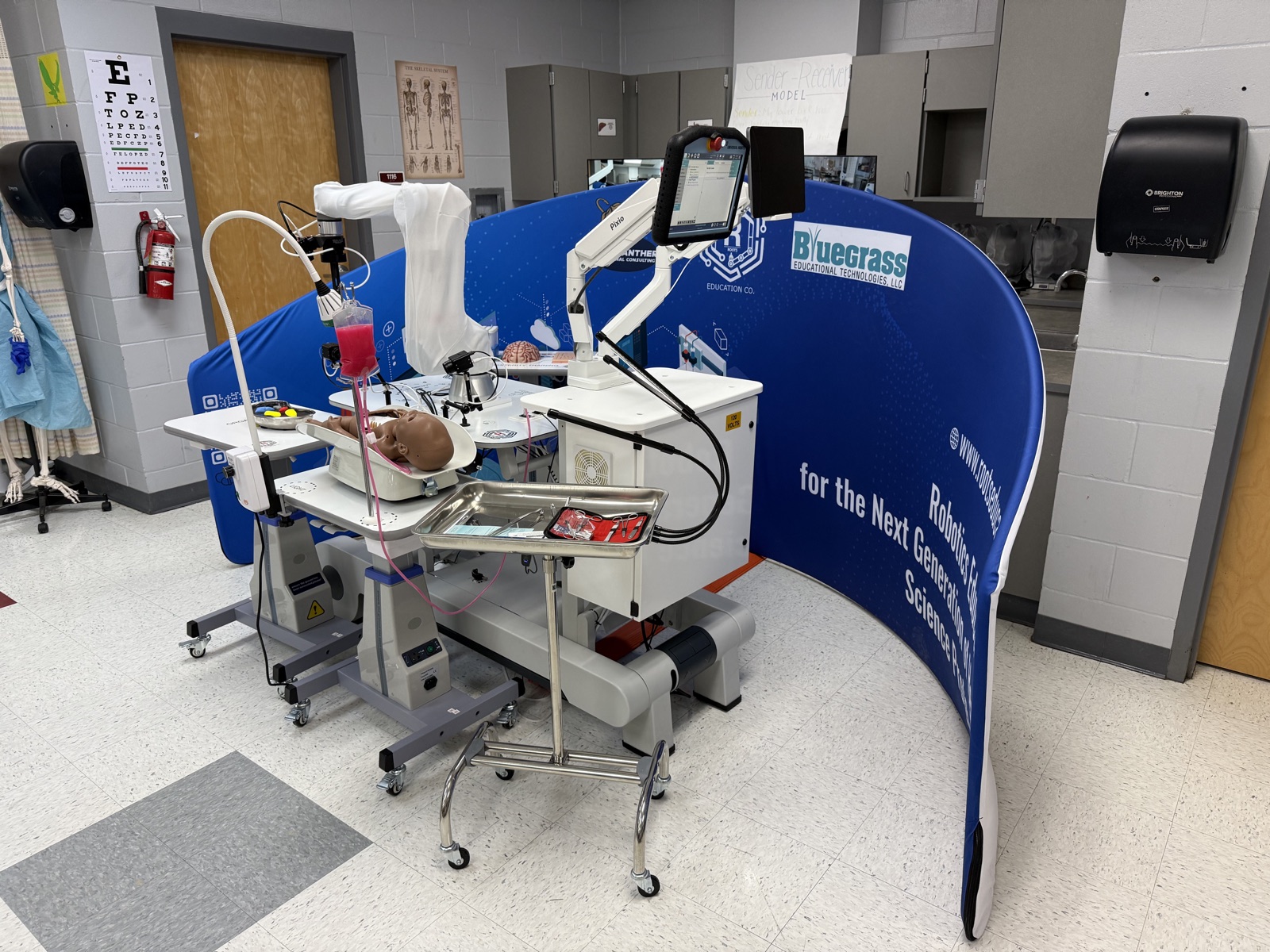
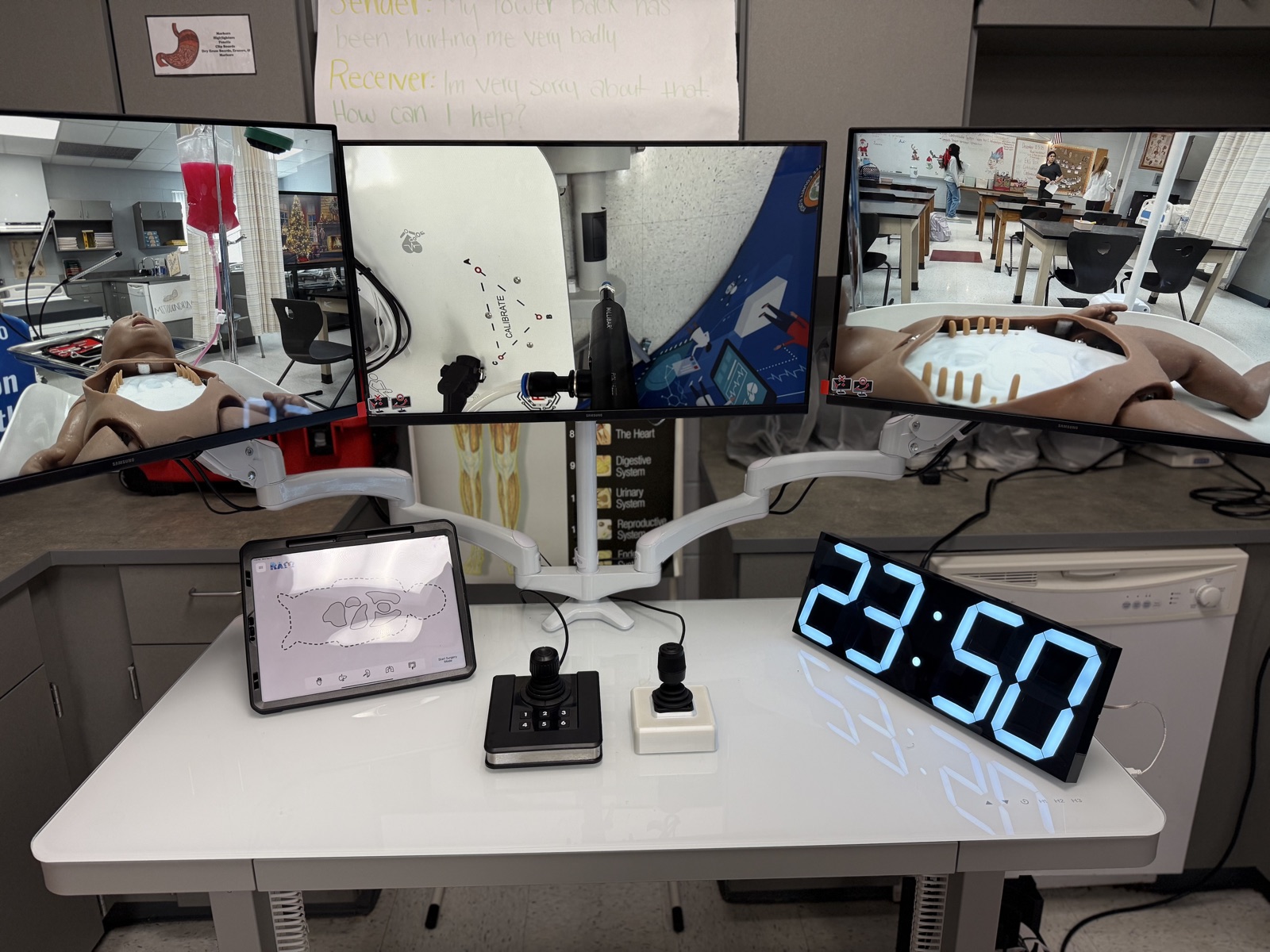
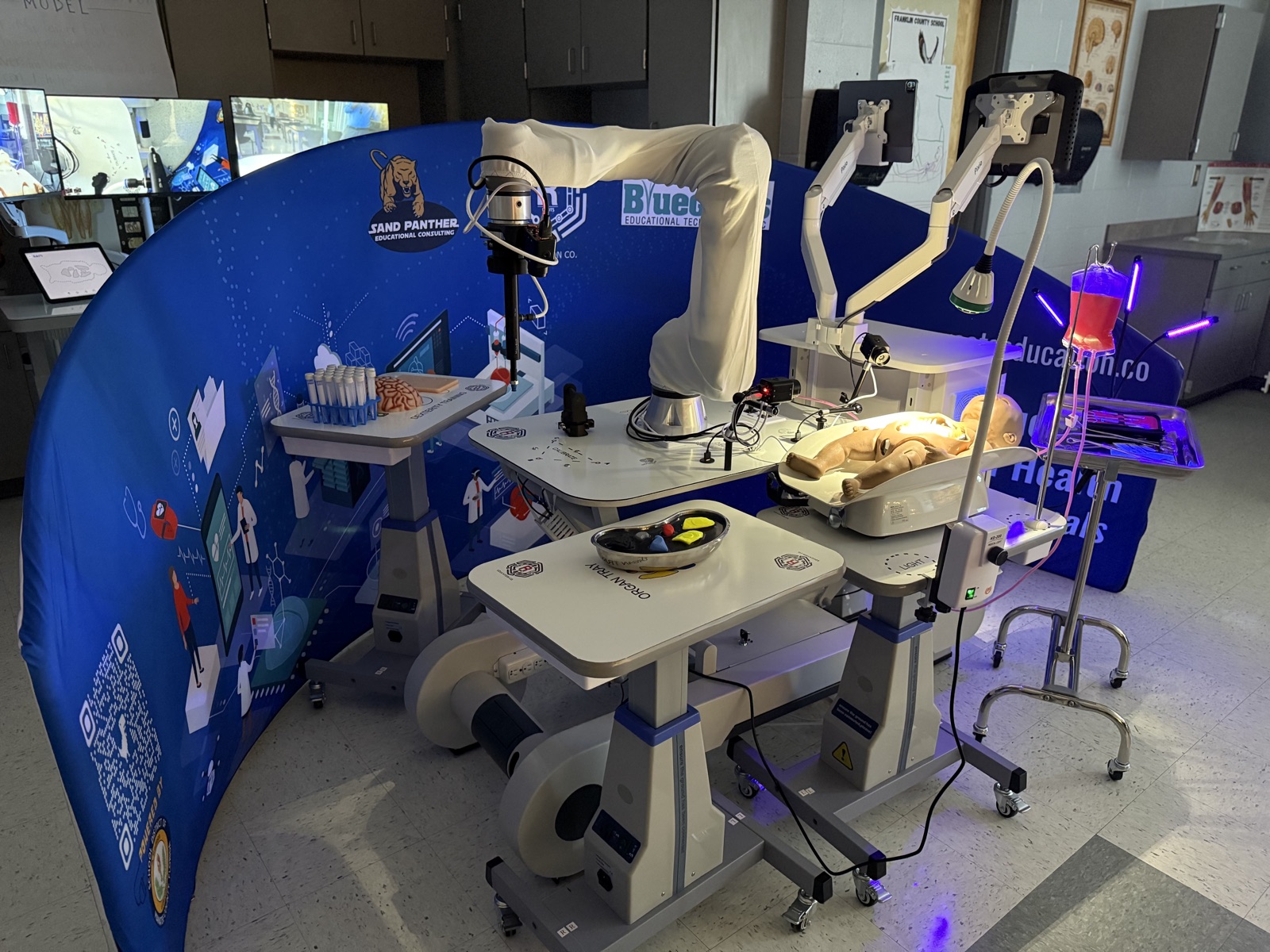
These photographs show a CARE installation configured for hands-on healthcare robotics education, multi-view visualization, collaborative robot operation, and applied simulation activities.
Hands-on simulation
Use mannequins, anatomical models, cameras, instruments, and simulated materials to explore healthcare procedures and robotic assistance.
Collaborative robotics
Develop safe operating habits, teach-pendant familiarity, manual movement skills, calibration awareness, and robot-programming fundamentals.
Machine vision
Work with multiple camera views, visual feedback, alignment, observation, and operator-interface concepts in a realistic learning environment.
Complete implementation
Combine equipment, curriculum, assessments, LMS delivery, instructor preparation, installation, and continuing support.
A five-module healthcare robotics curriculum
The CARE curriculum moves from healthcare and robotics foundations into safe operation and increasingly advanced programming. Interactive lessons include objectives, checkpoints, assessments, applied exercises, and a medical-robotics glossary.
Module 1
Robotic Surgery in Healthcare
Introduction to robotics, robotically assisted procedure concepts, system components and functions, and emerging healthcare technologies.
Module 2
Fields of Application and Safety
Healthcare applications, medical-robotics laboratory safety, personal protective equipment, sanitation, and essential healthcare skills.
Module 3
Robotic Operations
Collaborative robot safety, manual operation, teach-pendant skills, operating controls, and future developments in medical robotics.
Module 4
End Effectors and Basic Programming
End-effector concepts, actuators, tools, payloads, motion types, coordinate systems, and introductory robot programming.
Module 5
Advanced Robotic Operations and Programming
Tool coordinate systems, acceleration, blend radius, path optimization, program flow, and safe, efficient robot operation.
Skills students can explore
- Collaborative robot safety and risk awareness
- Robotic system components and terminology
- Teach-pendant navigation and manual operation
- Camera placement and multi-view visualization
- Tool and end-effector concepts
- Payload, calibration, and coordinate-system fundamentals
- Waypoints, motion commands, and program flow
- Acceleration, blend radius, and path optimization
- Healthcare laboratory safety and sanitation
- Personal protective equipment and sharps awareness
- Anatomy, dexterity, and procedure-simulation concepts
- Communication, documentation, and teamwork
More than laboratory equipment
A CARE implementation can bring the physical learning environment, instructional content, and faculty preparation together under one coordinated plan. The final configuration is developed around the institution’s learners, facilities, program goals, faculty capacity, and applicable safety requirements.
- Education-focused collaborative robotic system and supporting simulation equipment
- Healthcare and robotics curriculum with student assessments
- Customized learning management system access
- Instructor or train-the-trainer preparation
- Installation, integration, and learning-space planning
- Program alignment with institutional and regional workforce priorities
- Continuing technical and instructional support
Components and activities vary by selected CARE configuration. ROOTS works with each institution to document the intended instructional scope before implementation.
Who CARE can serve
Introduce health science, robotics, engineering, anatomy, and career awareness through a shared applied-learning platform.
Connect allied-health and automation instruction through short-term, certificate, continuing-education, or customized programs.
Support interdisciplinary exploration involving healthcare technology, robotics, biomedical systems, and human-machine interaction.
Create awareness of emerging healthcare technologies while developing transferable automation, safety, and technical skills.
Career-pathway alignment
CARE can support exploration and curriculum alignment related to robotics technicians, surgical technologists, physical therapist assistants, biomedical-equipment roles, automation technicians, and other healthcare-technology occupations. CARE by itself does not provide professional licensure, clinical qualification, or guaranteed employment. Requirements are established by employers, educational institutions, licensing bodies, and credential issuers.
Educational simulation notice
CARE is designed for education and simulation. It is not intended for clinical diagnosis, treatment, surgery, physical therapy, or use on patients. Mannequins, anatomical models, simulated materials, and training scenarios are used to support instruction.
Frequently asked questions
Is CARE intended for use on patients?
No. CARE is an education and simulation system. It is not a medical device and is not intended for diagnosis, treatment, surgery, therapy, or patient care.
Does CARE include curriculum?
Yes. CARE includes a structured five-module curriculum with lesson objectives, interactive content, assessments, applied activities, and medical-robotics terminology. The delivery plan can be aligned with the institution’s course structure and learner population.
Do students learn to program a collaborative robot?
Yes. The curriculum progresses from safe robot operation and teach-pendant familiarity to coordinate systems, waypoints, motion commands, payload concepts, acceleration, blend radius, path optimization, and program flow.
Can ROOTS prepare instructors?
Yes. Instructor preparation, train-the-trainer education, implementation planning, and continuing technical support can be incorporated into the CARE engagement.
Can CARE support more than one academic department?
Yes. CARE can support interdisciplinary collaboration among health sciences, allied health, engineering technology, robotics, automation, biomedical technology, and career and technical education programs.
Build a healthcare robotics learning environment
Share your target learners, courses, facility plans, faculty needs, funding timeline, and desired launch date. ROOTS will help your team define a CARE configuration and implementation plan that connects healthcare education with the technologies shaping modern work.
Request a CARE planning conversation Call ROOTS Education
Explore the complete ROOTS workforce training platform portfolio, including industrial robotics, semiconductor technician training, and logistics automation.